Uusi artikkeli Lontoon Draw to Perform 3 – symposiumista.
The new article on DTP3 by Brooke Carlsonpdf: 09_c_pajj_a_00352-carlsonhttp://www.mitpressjournals.org/loi/pajj
Between Spaces 1#
Video from a live drawing performance at Draw to perform 3, London
Coming soon! New video from Draw to Perform 2016
New video clip from the performance at Draw to perform – symposium 3 in London
link: https://drawtoperform.com/draw-to-perform-page/draw-to-perform3/
Replies to Silent questions and comments
Our apologies for our recent silence, in terms of not replying to your queries – we have had a lot of interest in the project. Here are replies to some of your queries, rather than answer all individually. Thank you so much for your interest. We are hatching plans to run more workshops. In fact it is very short notice but there is a DoBeDo party on Koh Mak island, Thailand this evening 5pm sunset, Thai time. You are very welcome!
Do let us know if you are inspired to run a DoBeDo. You can use our skeleton guide. We would love details of how your Do Be Do goes, and your students’ / party goers’ feedback.
Our replies:
Hello Emma and Angela,
I’m interested in knowing more about the student responses to the silent drawing party. Am particularly interested in the use of the masks.
Best regards,
Katie Ries
Hi Katie
We have some feedback from the students – written, drawn and recorded discussion provided after the party. We will transcribe and post asap.
But in summary they were very positive about it. Particularly one student who is autistic, who said that it was a relief and a normal day for her, in that it was a natural way for her to communicate and that words are a struggle. I think that it probably lessened the sensory overload for her, by excluding chatter.
Re the masks: we wanted to exclude facial gestures, to focus the communication into their drawing.
We spent a day preparing together for the party / do, discussing the rules we would follow, and making our masks. We also did preparatory self-portrait drawings and poems, to explore differences between verbal and visual communication.
An interesting aspect was that we agreed to try not to even use words ‘inside’ our heads – so that it would become as non verbal as possible. But afterwards several students said that they had forgotten that and had been quite focused on verbal thoughts and how they might translate into visual. Next time we run this we are going to weave our way more slowly from verbal to visual, with a day WITH verbal thought, and then trying out ways to minimise verbal thought, and see how differently we communicate without words.
We have a 3 day DoBeDo coming up in a mill house in Normandy, France in April. Dates to be confirmed shortly.
Name: Alejandro Quiroz
- Comment: I would like to know more about this project, Since I am working out on a research using drawing as an educational & comunicational tool with people with intellectual disability. While drawing offers a wide fields of art practices I believe it could develop as well other skills related with cognitive, motor, perceptual and affective issues. My best!
Dear Alejandro
Please follow this blog, to receive updates on the project. I am researching drawing for people who are non verbal – specifically those with autism, dementia and stroke damage. Exactly, drawing is not just for art, it is a motor and perceptual and cognitive skill. We post any current research we can find on this on the Facebook page Thinking through Drawing
https://www.facebook.com/drawingandcognition/
Where are you working?
Do keep in touch, and we can further discuss the role and potential of drawing.
Angie
3) Name: Thomas Bosket
Comment: How did the masks help?
Reply: Students said they liked not always knowing who each other was. They said they formed new bonds with other students. It was v interesting that some who identify as social and quite extrovert said they found the whole experience a bit uncomfortable and anxious-inducing. Others felt MORE comfortable than usual at a party. I think the masks helped a lot by not allowing communication by facial gestures. I was also surprised that hand and body gestures seemed not to come into play very much – the students really did use drawing to communicate, e’g. leading one another by lines around the party. Rather than communicate ideas, students said they felt like much of the time they were playing – often by mirroring one another. I was interested in what a visual version of ‘interrupting’ might be. It connects with what we have been doing in the Drawing Circles, responding to one anothers’ drawings, sometimes drawing ON, through, in each others’ drawings. These students were pretty ready to draw over and / or erase one anothers’ work – Emma had already done a few weeks of collaborative drawing with them, so they were very primed.
4)
Name: Susan Beniston
Comment: Dear Angie and Emma,
Hope this finds you well. Thanks for sending this post – it looks really great, most intriguing x the collaboration of 18 students…
If you have more info on the process, or the structure I would love it. Even links would be more than fine – if you can do so, please send me some more? I have 150 students this term, 32 in each studio section and they are far from silent – so this is inspiring.
Hard to believe its almost been a year since, We ALL Draw. I wish I could have participated in ALL the great workshops, that were given… Still it was a great hit, and is well-worth-savouring.
Kudos on your latest research and HeARTY Cheers to you both!!
Susan
Reply:
Thanks so much Susan!
We have written up some notes here on the structure we used. See https://emmafalt.net/2016/10/10/drawing-in-silence/
However you can just go ahead and see what happens. The main thing was that we spent a day with the students devising our silent rules together. I like the idea to have one or two part hosts though, as then they have a special role, introducing people to one another and trying to help them feel welcome and comfortable. Without officially agreeing this I felt that I took on this role. One student said she was grateful that I introduced, by drawing a line for her to follow, to a group of people drawing together, as she was feeling awkward and didn’t know how to join in.
I hope you try it. And do please let us know how it goes.
Btw the symposium proceedings with workshop details from WAD will be ready very soon.
5)
Name: Anne
Comment: My husband has a severe TBI. We are both artists. Primarily we draw. Now, after his accident we draw. I believe it is helping mend his brain.
I would love to discuss this more with you…
Angie
6)
Name: ranasamir
Comment: Hi Emma,
Looks like a great idea. Just wondering if you could comment on the actual process? I see the pictures you have but were the participants instructed before the activity? Was there a theme? What did the actual communication between two individuals or within group look like?
Thanks.
Reply: Hi. We will post more about the process soon, once we have transcribed the audio of the feedback. See https://emmafalt.net/2016/10/10/drawing-in-silence/ for more details about the process and structure. There was no theme – we agreed to have a silent party and to try to communicate by drawing alone. The communication looked like marks, lines, some representational images. There was a lot of colouring in, adding to images, erasing. It was ever changing on the paper, images often disappeared, were overlayed, erased. It was dynamic and physical, felt an embodied way of communicating.
Angie
Drawing with art – Open workshop at Kuopio Museum
PIIRRÄ TAITEEN KANSSA la 19.11.2016 klo 12-15
Taiteilija Emma Fältin ohjaamana heittäydytään dialogiin Seitsemän jättiläistä -näyttelyn kanssa ja tutkitaan piirretyn viivan mahdollisuuksia. Työpaja on maksuton ja soveltuu yli 12 -vuotiaille. Ilmoittautuminen p. 017 182 633.
Drawing without words
Angela Brew and Emma Fält
Q: How can we communicate/connect with one another without using words?
We invited 18 art students to a silent drawing party at Art School MAA, Suomenlinna Finland to begin a collective exploration of the power and limits of drawing.
Research interests:
- Thinking through drawing
- How it feels to be silent and draw together
- Effects of imposing limitations on human communication
- Insights into origins of verbal language – why we learnt to speak
…
Do ItYourself – simple instructions for starting
Do Be Do – Silent Drawing Parties
What? 2 day drawing workshop
For who? 1-2 “Party hosts” and 10-15 students/participants
Why? To explore how we can use drawing to communicate and connect with one another without words. Effects of imposing limitations on human communication.Insights into origins of verbal language – why we learnt to speak?
…
1st day : Preparing the party with no words
Materials: Big paper or cardboard (1A), any type of pens, pencils, ink
Methods: Speech, writing, drawing
Scedule
2-3 hours: Self portrait and identity
- Draw self portrait on big paper
- Writing words about oneself around the portrait
- Turn the paper around and write more words connected
- Read the words as “rhythmical poems” and
- Discussions about drawings
2-3 hours: Preparing the silent party
- Rules & limits: What you can and what you cannot do, needs: food, drinks and materials. Rules for the day: 1. Be silent: This means not using your voice to communicate. 2. Wear a mask* and neutral/dark clothes 3. Use only charcoal 4. Decide beforehand How the group will document the party (whether you take photos, record sounds, write after meetings etc)
- * Mask: Everyone creates a plain cardboard mask. You could make it from one color, simple cardboard and make holes for eyes and mouth. The purpose of the mask is to prevent the use of facial expressions while drawing and listening to one and other. If you start feeling very uncomfortable, e.g. with the paper on your face, you can take it of. Please try not to use your eyes, face and gestures to communicate. Focus on the drawing.
- Preparing the space: Clean and empty the room for setting the papers. You can set the papers
2nd Day: Party – Drawing Do Be Do
Materials: Big paper rolls to cover the floor and some walls, charcoal and masks
10:00 Everyone is coming to the classroom in silence and preparing themselves to have a party with no words. How do you feel today? Who would you like to connect with? How can you make that happen only by using drawing? You don’t need to draw all the time, remember to breathe. Pay attention to how you are feeling and consider using drawing to express and cope with emotions. Remember to take care of yourself. Bring enough to eat drink and take a break from the room if you need one (but, please maintain silence during your breaks).
10:15 Drawing starts
14:00-15:00 Discussion about the day, your thoughts and feelings.
Afterparty:
Discussion and reflecting what happened.
Sharing your feelings, ideas and next party
Please let us know how it went : You could send us some feedback, comments, photos, video or any kind of documents about your drawing sessions!
About our new project at thinking through drawing website:
http://www.thinkingthroughdrawing.org/blog
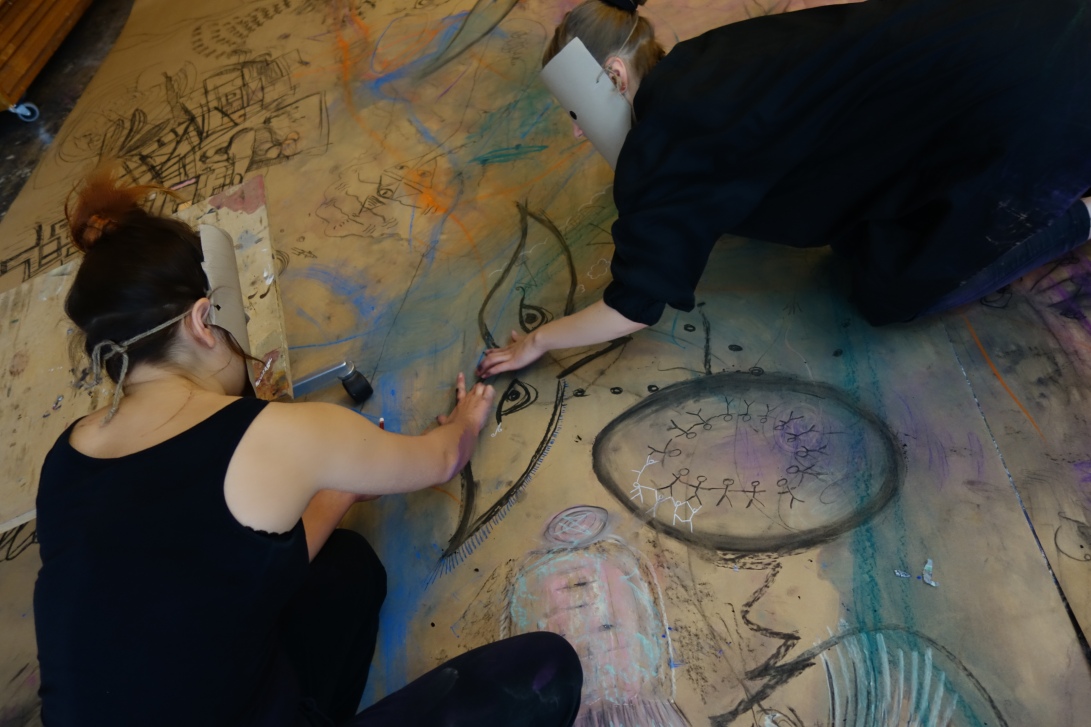
Drawing without words – New project with Angela Brew
 28.9.2016 Artschool Maa, Helsinki
How can we communicate/connect with one another without using words?
We invited 18 art students to a silent drawing party: to begin a collective exploration of the power and limits of drawing.
Research interests:
- Drawing as listening
- Thinking through drawing
- How it feels to be silent and draw together
- Effects of imposing limitations on human communication
- Insights into the origins of verbal language – why did we develop speech?
Secrets – performance at Sotku, Kuopio
Esitykset –
Pe 21.10. klo 19.00 KANTAESITYS
La 22.10. klo 19.00
Sotku, Suokatu 42/2, Kuopio
Suosittelemme yli 12-vuotiaille.
HUOM! Yhteen esitykseen mahtuu vain 25 katsojaa!
Liput: 18/10€
Paikkavaraukset ennakkoon: itak@itak.fi / 050 581 6300
Liput myös puolta tuntia ennen ovelta.

Emma Fält ja Arlene Tucker
Salaista – piilotetun käännöstyöstä
Kuvaus:
Salaisuus on jotakin piilotettua, jotakin josta ei saa kertoa. Sanaan liitetään häpeää, pelkoja ja outoutta, mutta myös herkkyyttä ja rakkautta. Onko piilotettu maailma jotain sellaista, jonka haluaisimme paljastaa tai joka paljastuu kuin itsestään? Kuinka tehdä esitys asioista joista ei saa kertoa?
Salaista on esitys, jossa taiteilijat lähestyvät sitä, mistä ei voi puhua. Teos perustuu kirjeenvaihtoon, sekä sarjaan monitaiteisia työpajoja, joissa on tarkasteltu peittämisen ja paljastamisen teemoja. Piirroksen, äänen ja liikkeen kautta rakentuva kokemus kutsuu pinnan alaiseen maailmaan.
Taiteilijoista:
Arlene Tucker on taiwanilais–amerikkalainen taiteilija, taidekasvattaja ja pelisuunnittelija. Hän tuo taiteessaan pelin ja leikin elementtejä osaksi elämäämme. Tucker on kiinnostunut käännös teorioista, eläimistä ja luonnosta, joista löytää yhä uusia kontaktin luomisen tapoja ja tietoa siitä, kuinka luomme merkityksiä meitä ympäröivässä maailmassa. Tucker on asunut Suomessa vuodesta 2011 ja asuu nyt Helsingissä.
Emma Fält on Iisalmelaislähtöinen taiteilija, joka työskentelee piirtämisen, installaatio- ja esitystaiteen parissa. Hänelle piirtäminen on kuuntelun, tunnustelun ja luopumisen tapahtuma, jonka kautta maailmaa avautuu yhä uusilla, runollisilla tavoilla. Hän työskentelee monitaiteisesti ja antaa piirroksensa vaikuttua liikkeestä, äänestä ja vaihtuvista ympäristöistä.
Fält ja Tucker ovat tavanneet vuonna 2014 Virossa. Yhteistyön käynnisti kiinnostus piirtämiseen, sekä leikkiin ja käännösteorioihin osana taiteen tekemistä. Salaisuus on tekijöiden ensimmäinen yhteinen pitkäkestoinen esitys, jota on ryhdytty työstämään vuonna 2015. Teemaan he tarttuivat, sillä se vaikuttaa yhdistävän kaikkia ikään, sukupuoleen tai taustaan katsomatta ja luo arvokkaan mahdollisuuden sukeltaa omaan ja toisen tuntemattomaan.
YLEISÖTYÖPAJA
Salaisuuksien käännöstyöstä – Translating the hidden
Maanantai 17.- Keskiviikko 19.10. 2016Klo 17-20
Työpajassa pohditaan mitä ja millaisia ovat salaisuudet? Miltä tuntuu kantaa asioita, joista ei saa puhua? Mikä piilotetaan ja miksi? Millaisia salaisuudet olisivat jos ne olisivat sanatonta laulua, ääntä, liikettä tai piirroksia tilassa. Miten asiat paljastuvat ja mitä niistä sitten tulee?Ryhmä käsittelee teemaa äänen, piirroksen ja liikkeen kautta itsenäisesti ja yhdessä.
Työpajaa varten taiteilijat Fält ja Tucker ovat keränneet materiaalia jonka pohjalta harjoituksia työstetään. Luomme leikkejä, joissa etsitään, paljastetaan, peitetään ja tirkistellään. Tehtävien kautta kerrottu, kirjoitettu ja puhuttu kääntyy tuntemattomille kielille saaden uusia muotoja ja merkityksiä.
Työpajaan osallistujat voivat osallistua perjantain tai lauantain esityksiin. Työpajaa suositellaan yli 16 vuotiaille. Osallistujamäärä maksimissaan 25 henkilöä.
Lisätietoja : https://salaistablog.wordpress.com/
Ja Itäinen Tanssin aluekeskus, Sotku
, Suokatu 42/2, 70110 Kuopio
itak(at)itak.fi
On Loneliness and contact workshop at Draw to Perform 2016
Visit to Draw to perform symposium 31.7.2016
On loneliness and contact – workshops series
15 participants
Materials: Ink, Sticks and Brushes on paper
Duration: 1 hour drawing and discussion
Workshop is a journey through loneliness. Group will create collaborative drawing by using Ink, brushes and sticks and leaving traces of their movement and sounds on paper.
This work done in group proposes ways to study contact with other and self. Workshop ponders the limits of ones physical body. It explores the space between energy and emotion, where the words have disappeared or not yet born.
Background: The project started as a social project with a group of young people in Northern Savonia, Finland. Work has been going on now for 2 years and is done in collaboration with The Regional Dance Center of Eastern Finland (ITAK) and supported by Arts Promotion Centre Finland and The Finnish Cultural Foundation.

