DRAWING OUT LOUD – Diary 2026
This is a diary for drawing & sound experiments. My attempt is to find new ways of thinking about drawing and making it.
I will ponder the relationship between trace, gesture, sound and touch. I am inspired by connecting with the surroundings and matter, improvised acts of drawing and nonverbal dialogue. In this diary I will post images and sound samples and ask the following questions among many more:
-
What does drawing do?
-
What inspires me to draw? Thoughts on Togetherness and listening as key elements of the drawing practice
-
What does it sound like when I am creating drawings?
-
What can we communicate through the acts of drawing?
-
How does the act of drawing/listening affect my understanding of my surroundings?
- Collective body and the sense of agency in the drawing process – explorations and thinking about the significance of drawing in promoting agency and participation.
Last but not least the reason for making this diary is the desire to learn more about sound technology and sound in general. I hope that some of you could be inspired or interested in the following learning process in drawing and sound.
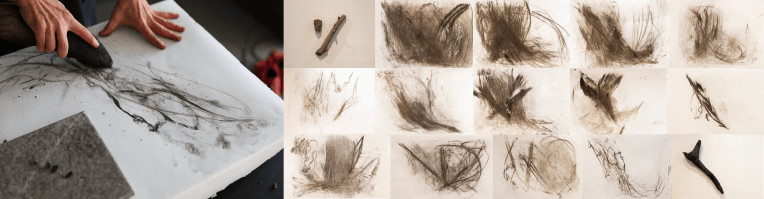
03/2026 DRAWING INSTRUMENT VOL.1
Last year was about practising and learning a new tool that I play by drawing. Invitation to Dance – project, brought me back to the origins of where I started with drawing and sounds: Tactility, touch, listening to the trace. In Invitation to Dance, I play with industrial materials that are creating a certain variety of drawing sounds, using my new self-built drawing instrument I will be writing about.
I am doing research on the drawing that is born from the point of view listening and contact instead of looking. I am mainly interested in the drawing process that is not visually directed, because of the different spaces and possibilities it offers. I am studying shared spaces and collective bodies in my practice. For me the space is a creation of encounters and I feel that drawing practice mainly explores a possibility to understand our listening processes and encounters better through these acts. Also in drawing and making soundscapes I am studying how the space is building up, changing and how that encounter changes me as I am playing/drawing / listening.
In drawing/playing together with Anna and Andrea in Invitatoin to Dance, I thought about the visuality as a co-creation where the others who are performing and creating ( singing and playing )never actually touch the drawing, but had their influence on it. So with my new instrument, I will go back to my favourite subject: collective making/togetherness of drawing.
What is the drawing instrument ?
The basis of my tool is an old folding camping table, I bought (half)intentionally from a fleemarket years ago. Inside I have contact 2-3 michrophones. Before, I experimented more with different types of mics (multi-pattern small-diaphragm condenser microphones ect) but here it was needed to capture and record the drawing sound straight from vibrating solid surface / materials to isolate the signals from instruments, machinery, and surfaces without picking up ambient noise. Providing a “dry” sound and revealing structural resonances, creaks, or internal sounds that are usually inaudible, were useful features to make the drawing sound actually possible to sense in the stage setup that includes so much sound from so many different sources. Also, now that we have been performing and creating the material, it did change the way I was playing and drawing. That is what I am interested in going back now. What did happen to me/trace/sounds when performing the drawing with this tool?
When we were working at Outokumpu Old mine residency last year https://oldmineresidency.fi/work-in-process-tanssiinkutsu-danceformations-performance-for-m_ita-bienniale-2025/ with Anna Fält and Andrea Mancianti, I started building the instrument for the Invitation to Dance – piece.
DRAWING MATERIALS
In that piece, I play using found materials, charcoal and my hands – a collection of stones, sticks, steel, iron and sand, and my own skin against the paper surface. Charcoal is burned wood, that I found much interesting in how it is handled and how much more variety I have when playing, compared to the industrially produced drawing charcoal.
Also, I have a stone plate on top of the box, that creates another layer of drawing sounds (echoing, clear, stony and high-pitched sound) when drawing on paper is more soft, granular, subterranean , low pitched. On the top of the box (even if its not very big) the drawing takes place over a wider area which brings its own special touch to the sound – it sounds more like something is travelling longer distances and you can sense its passage on the surface. I am curoius about the variety only using one instrument and what can be done with a simple stick/stone/grain. The effects and the program I am using, are a another year of writing about it.
But now, I am digging into the raw sounds and what can be done with what you have on your hands. The rythm, the play, the travel, the matter and what is it that I am listening to when playing with this instrument.
It is noteworthy that Invitation to Dance – performance is about ceremonial space, ritual, repetition, move and creating space with sounds to the participants to move their bodies and connect. This all is something to write about it relation to what I am doing with the drawing instrument.
For now, I give you some ideas in sound and video about it and come back on writing the following days.
First a sound example you can go and listen in Radio Helsinki, Pertin Valinnat-program, where Andrea Mancianti was being interviewed and they played an intro of Invitation to Dance. In the clip you can hear drawing sounds, vocals and Guitar + electronic music creating a special soundscape together.
https://radiohelsinki.page.link/1zV9
The next clip is made by Kulttuurijulkaisu IÄNI (https://iani.fi/), that came to visit my studio. In their video, I am playing the instrument to give an idea how it works. See their lates posts in instagram:
https://www.instagram.com/kulttuuri_iani/
This spring, I am writing you about some scores I have played, traces made and lets listen to it all together!
310423 drawing out Loud
For the last three years, I have slowly developed a larger project on drawing dialogues. It is a series of one-to-one performances, that take place in several locations in Finland and elsewhere. I have been and will be meeting a diverse group of people to create space together for listening and drawing together. The main purpose of the piece is to study non-verbal dialogue, togetherness and the importance of other senses than vision in the human encounter as well as in the drawing process.
I am especially interested in the soundscapes and tactile sense of drawing events. The participants will be able to take part in an improvisatory, non-verbal encounter which also creates traces other than visual ones, without, however, underestimating the importance of the visuality.
I am publishing here in my diary every month, some writing, soundscapes as well as visual traces about the meetings with the permission of the participants. Also, I will be writing a bit more about the process of developing the setup, if someone is more interested in that.
You are very welcome to read and also, don’t hesitate to contact me if you would like to participate in one of these dialogues.
Please, stay tuned!
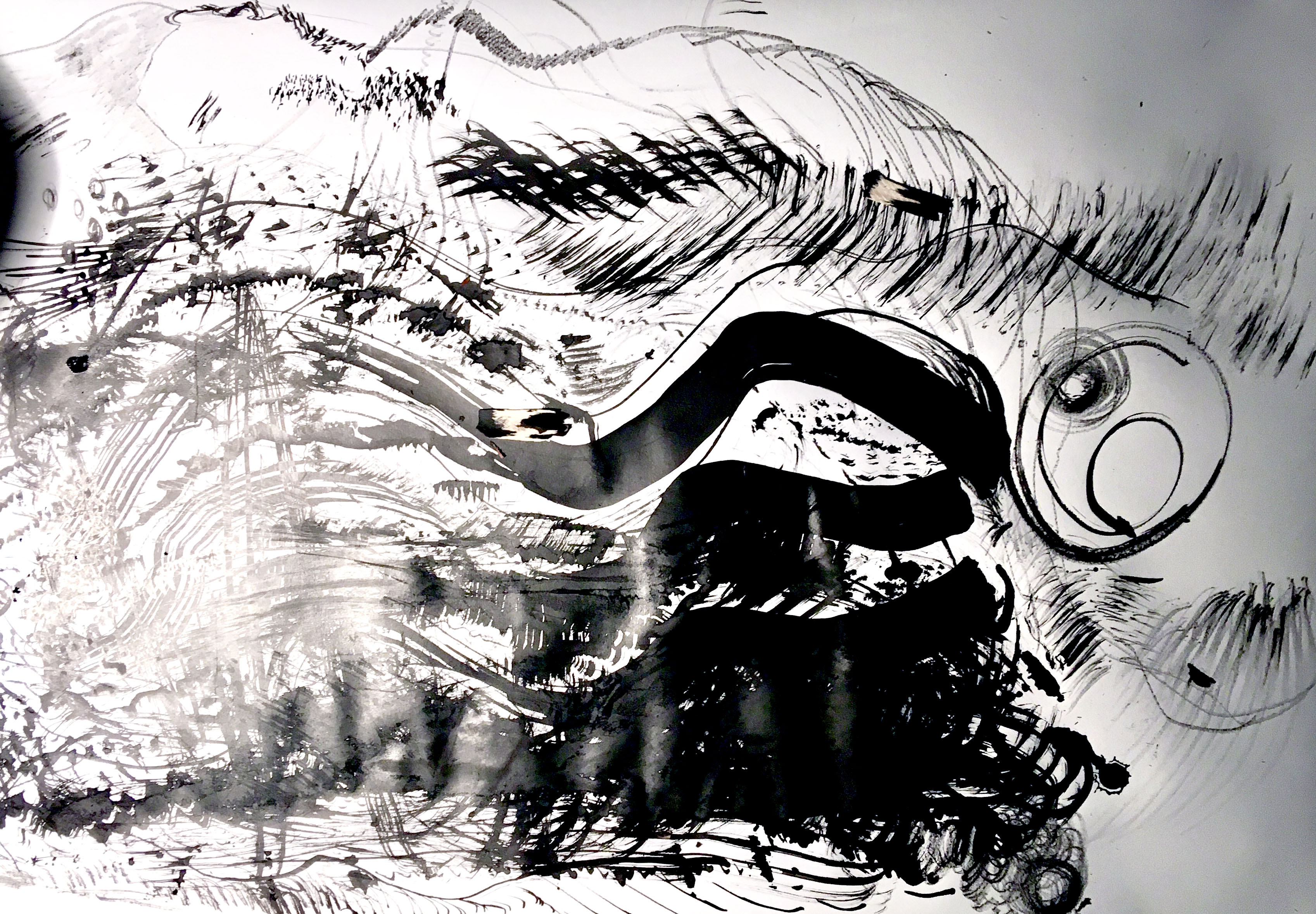
A dialogue, a memory from the Kehä festival in Oulu, 2020 where I started a new process with listening drawings.
280122 SOUND, MATTER & TRACE
Matter and sound are so interesting to ponder upon together because they are inseparable and everywhere we go. From the drawing point of view, I think trace is often understood as something visible in matter, but how do we understand and study the invisible trace? I guess sound does leave invisible traces. Is a memory an invisible trace or is it actually visible, showing from someones body or the way we touch? Probably there are a lot of traces that first seem invisible, but later on we notice that they become visible. Those can be result of long processes like climate change or memory loss, aging or wearing and tearing of certain matter.
To clear out my mind about the basic concepts I am writing about, I went to read basic physics about how sound and matter interact. In the study portal Instructor: David Wood writes the following:
Matter is the stuff in the universe: the physical material which takes up space and has mass.
Sound is what happens when you transmit vibrations of energy through that matter. Sound is made up of wave vibrations. When you talk aloud, the motion of your vocal cords causes the air to vibrate. Air is made up of molecules, and as those air molecules vibrate, they hit each other. Because of these collisions between air molecules, a sound will spread out from one side of the room to the other very quickly. (How Do Sound and Matter Interact?, 2015)
Everything we could quickly understand as something immaterial, is atleast very closely binded to matter. What interests me here, is the way drawing can reveal, follow and let us study by making processes. By tracing the observed at least part of it becomes visible. It could be drawing/tracing the wind movement, passing of time, thinking process etc.
My personal interest is though more in understanding the process of making/becoming. Through thinking about the soundscapes created by drawing, I am trying to dig deeper into what is essential in the process of the one drawing. At the same time I am interested in streching the boundaries of what could be called as a drawing. Could a soundpiece be a drawing? or maybe right way to ask is could drawing be presented as a sound art piece?
I think yes.
Why it is important. I could say I have no idea, but actually I might. One reason to do this is to emphasise one important role / mission drawing has. To imagine, to create new worlds and to live through the process aware of it. Why then no visible lines? Well, I am not very interested in creating a dicothomy of any kind about visual/non-visual, but I feel that focusing on the other than visual aspects of drawing can open a whole new world in understanding it better. Also, there is a strong personal need to move towards a world where all perception, all senses could be noticed equally. I am not convinced that this is the case now. I feel that image and visualising has an important role, but there are alot of things one can learn from learning to listen and by touching not forgetting our abilities to smell and taste.
Here I concentrate on listening and touching that are quite straight forward part of what I do.
I always start drawing from listening. It is listening to me. To draw simply means that there is a need and will to explore something. Then I will touch and listen to that.
For example:
I have recorded sounds of myself or others drawing for some years now. I will post some clips here in the diary for you to listen. As a comment to those sound samples, muy attempt is, what kind of knowledge can one find here? Some of these clips are part of a piece that I am currently creating to a group exhibition and later to a solo exhibition that will take place in Helsinki, Finland 2023.
Categories I will present year
1. Raw Drawing Sounds with more traditional tools
2. Drawing with and among matter
3. Recorded drawing dialogues
4. Processed drawing sounds (soundscapes created by drawing)
5. Soundscapes that are based on my drawings and the composed (using drawing as experimental notation)
SOURCES
How Do Sound and Matter Interact?” Study.com, 9 August 2015, study.com/academy/lesson/how-do-sound-and-matter-interact.html 28/01/2022
290520 Sand

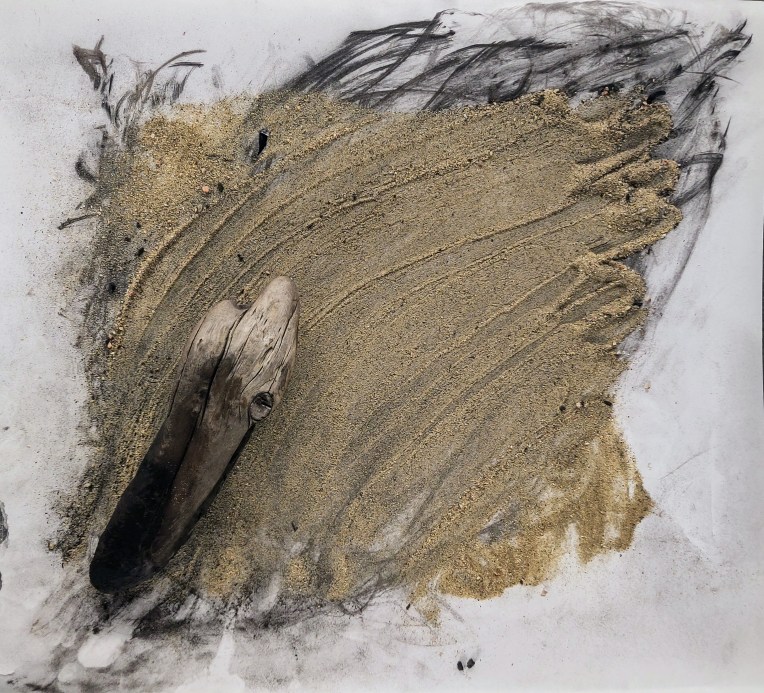
The sand I am using in this sound clip is from different sources:
From the arctic seashore in Finnmark, Norway and from Papinsalo island in Kuopio, Northern Savonia.
I was playing with the materials on top of a wooden table and a drumhead. There were certain improvised gestures inspired by the nature and state of the sand.
What was happening during these recordings was simply playing with the possibilities of sand that moves on the plate/drumhead. I tried to create different sound qualities, rhythm, melody, patterns and textures. When composing in Ableton, I played with simple ideas and basically studied the program while doing.
I was thinking about the space, time as well as how the different sounds play together. I tried not to edit too much what I recorded, but it is was challenging because of the possibilities what one can do to play with the sound. Next time different 😉
When I am listening to the sample it reminds me of the water, the movement of the waves. The movement that continues creating traces that repeat vanishing endlessly. The beauty of those traces is in their endless transformation and momentary nature. That reminds of freedom.
The images below present the process and the gestures made during the process of making. Swipes toward and away or passing the microphone, fingers swirling, fumbling, dropping on top of the sand and tapping the surface.


020620 Rhythmical properties of sand and two hands moving on different surfaces.
To continue from the previous experiment, I would like to dig deeper in different qualities and elements of the soundscape. What kind of sounds and sound qualities am I able to create with hands and sand? I will continue by creating another type of drawing/soundscape using the same substance, two hands in dialogue and mimicking each others gesture.
In today’s experiment, my attempt is to study the rhythm, the timing of events on a human scale; of musical sounds and silences that occur over time.
 Emma Fält - drawing out loud